Analysis of Biden approval margin
# Bidens Approval Margins

As we saw in class, fivethirtyeight.com has detailed data on [all polls that track the president's approval ](https://projects.fivethirtyeight.com/biden-approval-ratings)


```r
# Import approval polls data directly off fivethirtyeight website
approval_pollist <- read_csv('https://projects.fivethirtyeight.com/biden-approval-data/approval_polllist.csv')

glimpse(approval_pollist)
## Rows: 1,600
## Columns: 22
## $ president <chr> "Joseph R. Biden Jr.", "Joseph R. Biden Jr.", "Jos~
## $ subgroup <chr> "All polls", "All polls", "All polls", "All polls"~
## $ modeldate <chr> "9/17/2021", "9/17/2021", "9/17/2021", "9/17/2021"~
## $ startdate <chr> "1/31/2021", "2/1/2021", "2/1/2021", "2/2/2021", "~
## $ enddate <chr> "2/2/2021", "2/3/2021", "2/3/2021", "2/4/2021", "2~
## $ pollster <chr> "YouGov", "Rasmussen Reports/Pulse Opinion Researc~
## $ grade <chr> "B+", "B", "B", "B", "B", "B-", "A-", "B", "B-", "~
## $ samplesize <dbl> 1500, 1500, 15000, 1500, 15000, 1005, 1429, 15000,~
## $ population <chr> "a", "lv", "a", "lv", "a", "a", "a", "a", "rv", "l~
## $ weight <dbl> 1.0856, 0.3308, 0.2786, 0.3086, 0.2507, 0.8741, 2.~
## $ influence <dbl> 0, 0, 0, 0, 0, 0, 0, 0, 0, 0, 0, 0, 0, 0, 0, 0, 0,~
## $ approve <dbl> 46, 52, 54, 49, 54, 57, 49, 54, 60, 50, 54, 55, 51~
## $ disapprove <dbl> 38, 46, 33, 48, 34, 34, 39, 34, 32, 47, 34, 33, 46~
## $ adjusted_approve <dbl> 47.2, 54.4, 52.5, 51.4, 52.5, 55.9, 49.6, 52.5, 59~
## $ adjusted_disapprove <dbl> 38.3, 40.1, 36.3, 42.1, 37.3, 35.1, 39.1, 37.3, 33~
## $ multiversions <chr> NA, NA, NA, NA, NA, NA, NA, NA, NA, NA, NA, NA, NA~
## $ tracking <lgl> NA, TRUE, TRUE, TRUE, TRUE, NA, NA, TRUE, NA, TRUE~
## $ url <chr> "https://docs.cdn.yougov.com/460mactkmh/econTabRep~
## $ poll_id <dbl> 74332, 74338, 74366, 74347, 74367, 74345, 74348, 7~
## $ question_id <dbl> 139593, 139642, 139733, 139654, 139734, 139652, 13~
## $ createddate <chr> "2/3/2021", "2/4/2021", "2/11/2021", "2/5/2021", "~
## $ timestamp <chr> "13:01:54 17 Sep 2021", "13:01:54 17 Sep 2021", "1~# Use `lubridate` to fix dates, as they are given as characters.
approval_pollist <- approval_pollist %>%
mutate(modeldate = lubridate::mdy(modeldate),
startdate = lubridate::mdy(startdate),
enddate = lubridate::mdy(enddate),
createddate = lubridate::mdy(createddate))Create a plot
What I would like you to do is to calculate the average net approval rate (approve- disapprove) for each week since he got into office. I want you plot the net approval, along with its 95% confidence interval. There are various dates given for each poll, please use enddate, i.e., the date the poll ended.
# Create confidence levels
approval_margins <- approval_pollist %>%

  #Select enddate
  filter(!is.na(enddate)) %>%
  mutate(week=isoweek(enddate),
         margin=approve-disapprove) %>%

  #Group the data
  group_by(week, subgroup) %>%

  #Summarize data (use se formula for differences)
  summarise(
    mean=mean(margin),
    sd=sd(margin),
    count=n(),
    se=sd/sqrt(count),
    t_critical=qt(0.975, count-1),
    lower=mean-t_critical*se,
    upper=mean+t_critical*se)

glimpse(approval_margins)
## Rows: 99
## Columns: 9
## Groups: week [33]
## $ week <dbl> 5, 5, 5, 6, 6, 6, 7, 7, 7, 8, 8, 8, 9, 9, 9, 10, 10, 10, 11~
## $ subgroup <chr> "Adults", "All polls", "Voters", "Adults", "All polls", "Vo~
## $ mean <dbl> 18.00, 15.85, 12.00, 20.72, 16.82, 10.89, 19.81, 15.98, 13.~
## $ sd <dbl> 5.68, 8.94, 11.33, 4.37, 7.70, 6.90, 2.31, 7.60, 9.16, 3.71~
## $ count <int> 8, 13, 6, 12, 19, 9, 13, 25, 14, 13, 26, 15, 13, 22, 11, 14~
## $ se <dbl> 2.009, 2.480, 4.626, 1.261, 1.766, 2.300, 0.639, 1.520, 2.4~
## $ t_critical <dbl> 2.36, 2.18, 2.57, 2.20, 2.10, 2.31, 2.18, 2.06, 2.16, 2.18,~
## $ lower <dbl> 13.250, 10.442, 0.108, 17.942, 13.110, 5.585, 18.415, 12.84~
## $ upper <dbl> 22.8, 21.3, 23.9, 23.5, 20.5, 16.2, 21.2, 19.1, 18.3, 19.6,~#Create the graph
approval_margins %>%
filter(subgroup == "Voters") %>%
ggplot(aes(x=week, y=mean)) +
#Set colors
geom_point(color="chocolate2", size=1.5) +
geom_line(color="chocolate2")+
#Add fill between lines
geom_ribbon(aes(ymin=lower, ymax=upper),
color="chocolate2",
fill="grey87",
linetype=1,
alpha=0.5,
size=0.3) +
#Change limits, theme, scale, facet wrap and add fitted line
ylim(c(-15,50)) +
theme_bw() +
scale_x_continuous(breaks=seq(0, 35, 13))+
scale_y_continuous(breaks=seq(-15, 10, 2.5))+
geom_smooth(se=FALSE) +
#Add horizontal line
geom_hline(yintercept=0,
linetype="solid",
color = "chocolate2",
size=2) +
#Add labels
labs( title="Estimating Approval Margins (approve-disapprove) for Joe Biden",
subtitle = "Weekly average of all polls",
x = "Week of the year",
y = "Average Approval Margin (Approve - Disapprove)") +
NULL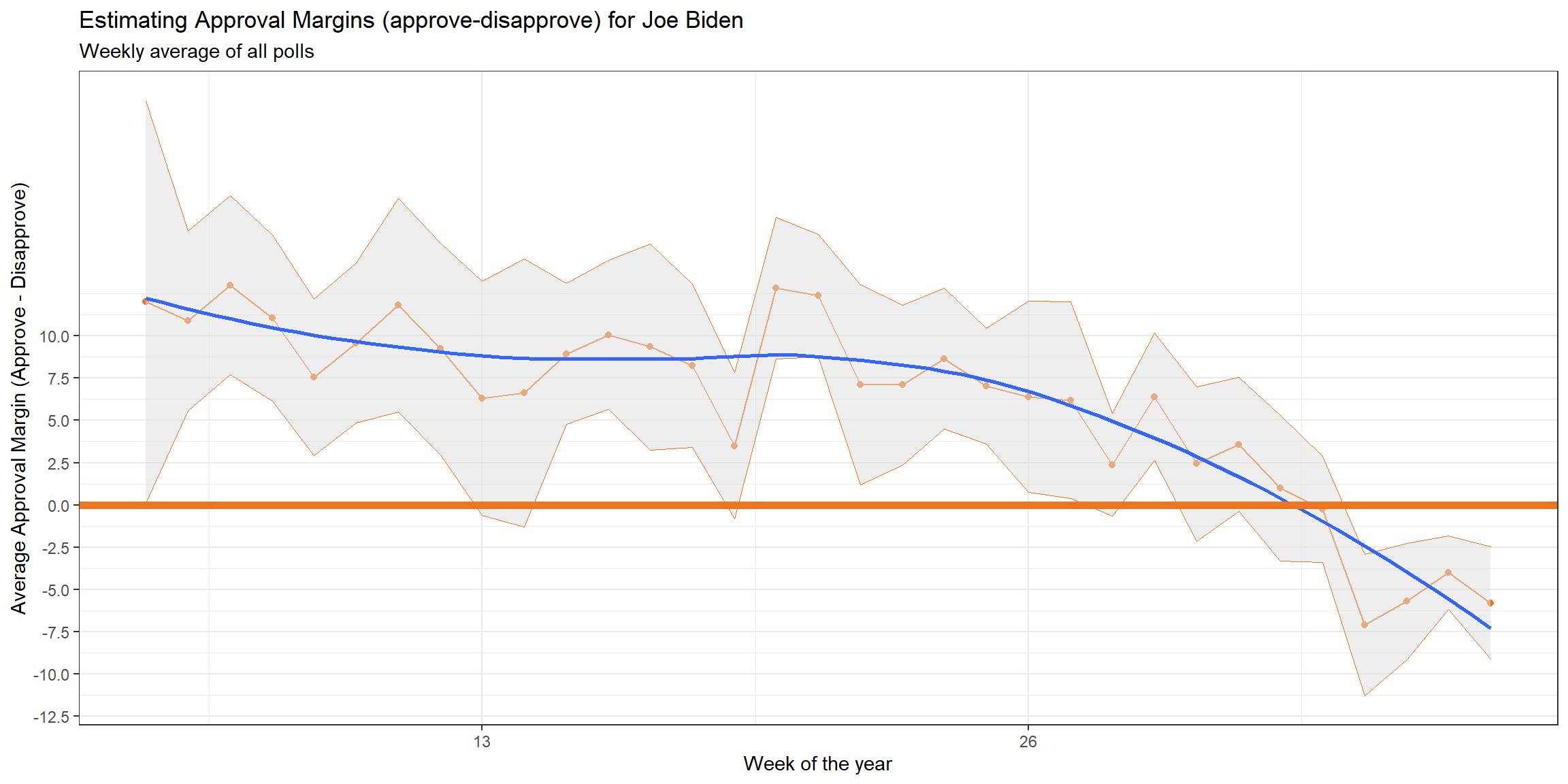
Compare Confidence Intervals
Compare the confidence intervals for week 4 and week 25. Can you explain what’s going on? One paragraph would be enough.
The sample set differs between week 4 and week 25. The sample size on week 3 is much smaller than that of week 25 which is why the standard error is relatively higher in week 3. This leads to larger confidence intervals in week 3 compared to week 25. As far as the data across the weeks is concerened, as sample size increases - confidence intervals shrink. The approval ratings for Joe Biden have reduced between week 4 and 25.